Sunday, November 13, 2011

Poppies as a Symbol


Born with a curiosity that makes me want to know more about the world around me, I constantly go on the search for answers to questions that form in my mind. With the recent Veterans Day, I began wondering why poppies have become the popular icon. This is what I found:

The red poppy worn around the world in remembrance of battlefield deaths has nothing to do with the blood shed in the brutal clashes of World War I.

Instead it symbolizes the wild flowers that were the first plants to grow in the churned-up soil of soldiers' graves in Belgium and northern France. Little else could grown in blasted soil that became rich in lime from the rubble.

Their paper-thin red petals were the first signs of life and renewal, and in 1915 inspired Canadian doctor John McCrae to pen perhaps the most famous wartime poem:

In Flanders fields the poppies blow
Between the crosses, row on row ...

It was this poem which inspired an American war secretary to sell the first poppies to raise money for ex-soldiers.

(Information from the BBC News magazine)

Friday, November 11, 2011

Veteran's Day, 2011


At the gym this morning a Vietnam veteran and I made some small talk. I mentioned that today was Veteran's Day, 11-11-11. He was wounded as shown by the logo on his pickup's license plate, and any attempt I've made in the past to try to get him to give some details of his war experience never got far. Today he said it was his wife's birthday. That was what was on his mind. On the "Morning Joe Show" this morning two Medal of Honor veterans talked about others. The panel all said they can never get any Medal of Honor winner to talk about his actions that earned the medal. They all say they were just doing their job.

A few years ago I wrote this and was reminded of it this morning.

-We Were Drinking Beer in Herb's-

We were drinking beer in Herb's
when Walter said, "Your dad should
have kicked your ass more often
just as far as I'm concerned."

Walt was a World War II vet,
a gunner in a bomber
who told of watching bullets
bounce off the armored belly
of German jets he shot at.
He flew thirty-some missions.
How could I argue with him?
Just maybe he knew something.

Then I looked beside Walter
to the next man. He'd once said
a man could have walked ashore
on floating soldier's bodies
killed while attempting to land
on gory foreign beaches.
He rarely spoke, yet his eyes
looked at me saying, "He's right."

The next in line at the bar,
a D-Day paratrooper,
spoke cheerfully, masking facts
of his war - hearing the screams
of Germans after he threw
explosives in their concrete
bunker. His box of medals
sat unsung, collecting dust.
In spite of his easy laugh
his eyes pierced this guy's know-it-
all attitude to say, "You
have a lot to learn yet, boy."

Though my spirit had weakened
from this beating I'd taken,
I could still stand at the bar.
My eyes settled on the vet
who hosted a metal plate
in his head for which he'd paid
a piece of his skull and brain.
The crew of his tank had stopped
to cook coffee. A sniper
traded his bullet for the flesh
of this man, neutralizing
forever his reasoning.
Those unfocusing eyes watched
me through a clouded beer glass -
was I friend or enemy,
the one who had wounded him?

I had entered this man's world
thinking I was an equal,
but this cadre proved harsh worlds
apart from mine existed.
That ragged line extended
further down the long counter,
and men's faces became blurred.
Each had his private story
and bore sore wounds in body
or mind. Retreat from their hell
was the better course for me.
Years have passed and none remain
to share these stories and shame
me into humility.
It is this I remember.

copyright, LBueling

Thursday, November 10, 2011

A Fool and His Money Are Soon Elected


I turn to Will Rogers for home-spun wisdom again. A fool and his money are soon elected. Who will it be this time around? The debates to date haven't brought the best in anybody yet. I'm at the point of feeling sorry for Governor Perry who wants to cut government spending by eliminating three departments but could only remember two of them. Cain keeps swatting at the flies in his past, but they keep flying around his head.

Alexander Hamilton started the U. S. Treasury with nothing, and that was the closest our country has ever been to being even. I don't know how accurate that is, but I think it is mostly so.

Anything important is never left to the vote of the people. We only get to vote on some man; we never get to vote on what he is to do. Lies, broken campaign promises, corruption with lobbyist payola. Happens all the time. Jack Abramoff who just served four years in the federal pen was on last Sunday's 60 Minutes show. He explained how easy it was to buy votes in Washington

Democrats never agree on anything, that's why they're Democrats. If they agreed with each other, they would be Republicans. Not much can be added here, although the united front as created by Grover Nordquist and his no tax increase pledge seems to have sprung a small leak in the dike.

I bet after seeing us, George Washington would sue us for calling him "father." If he had a sense of humor he might have laughed, but they had their share of arguments and fights, too. In fact political parties started because Hamilton and Jefferson couldn't agree on anything.

I don't make jokes. I just watch the government and report the facts. The comedians have such rich ground to harvest their routines from. I can't wait to see what SNL will do with Gov. Perry.

I have a scheme for stopping war. It's this - no nation is allowed to enter a war till they have paid for the last one. It's hard to predict when the generals and industry will tell us when it is time for another war, but it's fun to think in idealistic terms.

Finally,

I never expected to see the day when girls would get sunburned in the places they do now
.
One day this past summer I walked into a restaurant and there stood a young girl with a low cut top that drooped below her tan line. I went home and wrote a poem about ice cream sundaes.

Tuesday, November 08, 2011

Little Bit of Will Rogers


Today in North Dakota the Democrat Heidi Heidkamp announced she is going to run for the U. S. Senate. Already last week the Republicans expressed their fear of that and ran full page ads telling us why she was so terrible. So it goes. The talking heads on national news keep conjecturing who might be the Republican presidential candidate. One week it's this one, the next that one. The elections are still over a year away and here we are, being fed a heavy diet of propaganda from all sides. When I was old enough to start being interested in things of this nature I remember reading Will Rogers and his take on political affairs. He died in that plane crash in 1935, but his words make sense today.

* If stupidity got us into this mess, then why can't it get us out.

* The taypayers are sending Congressmen on expensive trips abroad. It might be worth it except they keep coming back.

* You can't say civilization isn't advancing; in every war they kill you in a new way.

* We can't all be heroes because someone has to sit on the curb and clap as they go by.

* Ancient Rome declined because it had a Senate, now what's going to happen to us with both a House and a Senate.

* This country has come to feel the same when Congress is in session as when the baby gets hold of a hammer.

* Everything is changing. People are taking the comedians seriously and the politicians as a joke.

Watch the late night comedians on tv and try to disagree with the last one. Leno, Letterman, Stewart, and all the others of their ilk make quite a bit of sense at times. The one I've liked the best of all was Tina Fay's Sarah Palin. That reminds me, where has Sarah been lately?


Sunday, November 06, 2011

Writing

Sunday morning. Sitting at this old oak library table and having just finished my regular scan of internet offerings, I think of how many people write. The internet is filled with fresh offerings by countless numbers of folks, some intellectually inspiring, some pure drivel which if we didn’t have that something called “freedom of speech” would be banned for its smuttiness.

Because I’m trying to write some myself, I found many sites on the internet that publish short stories where I can read and study hundreds, maybe thousands of them, with a couple computer clicks. The same goes for novels, poetry, religious tracts, science, porn, etc. Having just made my first humble attempt at writing a short story I can count myself in that total.

I sent the story around to five different people for them to read and criticize and received comments back from four of them, helpful comments which will be incorporated into the final draft. That story is quite unique to our region and I want to get it told well. Further stories will probably not appear here but instead will be collected into a volume and distributed. I finished a story regarding the prairie fire that killed so many people just outside of Fort Ransom and have sent it out to my readers. In the meantime the story of the freighter who traveled with Custer’s command who in his final years lived and died in Sheldon has been started. Who needs crossword puzzles or mental games to keep the brain stimulated from receding into dementia? Dreaming up a story line to support the historical facts is enough for me.
- - - - - -
The other day I picked up Bob Greene’s book Duty: A Father, His Son, and the Man Who Won the War in the library and enjoy reading in it for some diversion. The man who won the war in this story is Paul Tibbets, the pilot of the Enola Gay that dropped the A-bomb on Hiroshima. Greene writes respectfully of his father and Tibbets who both served in WW II. He reports of how blunt and clear-spoken Tibbets was in relating his experience. The bomb weighed 9,700 pounds and when it was released over its target the B-29 bucked and “The seat slapped me on the ass.” He then put the plane into a severe diving right turn to get as far away as possible by the time the bomb exploded. Tibbets’ said he sleeps well at night and never felt badly about the lives lost in that explosion, he always thought about the lives that were not lost because the war then ended abruptly. The author spoke several times of how he would interview Tibbets in cafes or bars and nobody knew who the man was.

Friday, November 04, 2011

The Blizzard - Part III, the final of a serial story

The sky finally lightened to let me gain some reference to this sorry state where we found ourselves. I needed to move about, stomp my feet, make the blood flow in my frozen veins, and talk to someone even if the wind ripped the words from our mouths. I climbed from the wagon, stumbled hands first into a drift, and began my hip-deep flounder. My god, how that snow had banked since last I tried walking to the next wagon!

I peered inside the canvas and saw a dark lump; I jabbed and hollered at it. It took a couple of seconds til it moved. From within I heard over the roar some muffled lines of coarse teamster talk that told me he was all right. One eye appeared and I heard him say, “We ever gonna get rollin' again?” I knew no more than he did but had not yet abandoned hope and wanted no part of pitiable talk so I quickly moved on to the next wagon.

In that cold, blowing whiteout, it was impossible to walk the length of forty-five wagons, so what we knew of our fellow drovers' well-being were rumors that made their way back and forth along the line, wagon to wagon, some so hard to believe like the one that had a man going berserk from snow madness who hitched up his team and drove off into the storm. Another had a man breaking out a bottle of liquor, the only thing left unfrozen, and guzzling it into his empty stomach. He passed out and the one who saw him in his wretched condition of frozen vomit-soaked clothes wondered if he were still alive.

If only a man could see into the distance. This white faceless world wore hard on me. I could as easily been back at Gettysburg with the smoke from the guns and cannons so thick you could not see a comrade beside you, let alone a Reb running with a bayonet pointed at your guts. At the Battle of Wilderness we could not see, either. We had the Rebs outnumbered and Grant wanted to meet them in the open, but Lee out-generalled us and lured us into the woods and evened out the odds. And, God, how we cringed when a brush fire broke out between the lines in no-man's land and the wounded men lying there suffered and screamed as the flames ate them alive. At least we did not have to watch them die as they lay veiled in the smoke.

Here our battle, though, was against the cold, the snow, the wind, the solitude, and if this storm persisted, men would die here, too. Another story started making its way along the line: the old teamsters were saying the oxen should have been set free at the outset so they could drift with the wind and fend for themselves. We could have rounded them up later, but here, they said, they will start dying soon if we do not get them up and moving. The wagon boss never gave any further orders contrary to his earlier one, so there the oxen lay with deep snow mounding over and around them.

We came to believe the story about the man going crazy and taking off with his team, at least it seemed verified in its retelling. I could only wonder about his fate, maybe he had found shelter and sat there thinking we should have followed him, but as sure as there is a heaven there is a hell. More than likely he died, frozen stiff on the prairie, experiencing the notion of being warm and, then slipping off into a deep, dreamless sleep.

The weaker, older oxen started dying but little could be done about it now. Maybe the same fate will come to us, hunched up as we were, shivering, fever setting in, craving water. Eating snow to slake our thirst brought scant relief, and I kept dreaming of a flame-scorched pot of boiling coffee hanging over a fire. If this hell did not soon end our carcasses would freeze stiff in what ever contortion the final heartbeat found us.

Pitch black darkness settled over us again, the end result being no different than if someone had tossed a buffalo robe over my head. What was this, the third night? I was as lost in time as in place. Horrid nightmares visited me, always on a battlefield. Men I had killed rose up through the musket smoke with their gaping wounds and began to come for me. I shot to stop them, but still they came. I tried running but my legs felt paralyzed, and I awoke in fright just as the bayonet plunged downward. Then the noise of the battle began to slack off, the cannons stopped, the shouting, the screams of the wounded horses and men, all vanished. Slowly I came to my senses, but something was different, what was it? I sat upright and shook my head. I welcomed the quiet after the din of the nightmares. Quiet! That was it, I did not hear wind roaring and whistling against and around the wagons. Lifting the wagon cover I saw a bit of light in the eastern sky, the top edge of the sun peeking over the horizon. The storm had ended, the sky was clear! We would roll again.

Thursday, November 03, 2011

Part II - The Blizzard - a story in serial form

This place was on the edge of everything we called civilization. West of here Indians hostile to our presence still roamed about, though we kept a sharp eye out for them on our trail,too. The fort seemed to be on constant alert and sentries watched around the clock for signs of an Indian attack. This was not a training exercise for the soldiers. Just the year before a company of men stationed at Fort Phil Kearney died in a battle when they rode to provide escort for a wood-chopping crew. Earlier their commander William Fetterman had said he could defeat the whole Indian nation with eighty men. Well, that is how many he led and that is how many died on the day known as the Fetterman Massacre. Then in August, just five months before we got here in Fort Ransom, Red Cloud's warriors again attacked a wood crew out of Fort Kearney. This time they and their escort of soldiers fared better when they arranged their wagon boxes to fight behind. New and fast-firing breech loading rifles evened out the odds, too, and they drove the Indians away. Now they are calling it the Wagon Box Fight.

More than a few of the teamsters were always on the lookout for a little fun, and when they mixed with the soldiers and blended in a little whiskey they grew raucous. A game of chance “Who is the best shot?” started up and almost ended with a dead man to bury. Tiring of shooting at targets set off a ways on the prairie and loosening up with more spirits someone suggested a more daring variation on the game, drawing straws to see who got to set a tin cup filled with whiskey on his head with the winner trying to shoot it off. The first few rounds turned out all right because no one could hit the cup, but the last time with a teamster doing the shooting he shot a little low and grazed the trooper's scalp causing blood to pour down his face. Neither group of men was without discipline; when the fort commander caught wind of the escapade he ordered the military men into the confines of the fort, and the wagon boss said if it did not stop he would withhold wages. So things settled down for the night.

At daybreak on the morning we started back such a commotion you never did hear as when those old bullwhackers' started cracking their whips and cussing at the beasts to get rolling. A grizzled old drover in St. Cloud taught me how to pop a whip that sounded like a gunshot over the oxen's ears, and with my skill and stock of swear words growing every day I added to the clamor. I thought of my mother back in Illinois who would have washed my mouth out with laundry soap if she could have caught me.

Men were bitching about their rheumatiz acting up and kept eyeing the sky and those thick, gray clouds that unrolled over us like a heavy rug. Even with the pulling of empty wagons ox teams travel slowly, so we had made only about twelve miles by mid-afternoon when the first snowflakes flurried down which made me wonder about the augury of aching joints. It did not take long for a snow storm to develop, it grew rapidly, and even with some remaining daylight on this short day of December, the fury of the wind and the growing drifts made us stop … here!

With little else to do, I arranged a nest for myself inside the windbreak of a wagon box. Lying there my thoughts wandered with no focus except that I kept thinking about finishing this journey and finding warm shelter and food. The oxen should be all right and would not suffer any more than the teamsters. So I lay all the night, shivering, stomach growling, and wishing to hell I was somewhere else besides in this predicament where the wind grew stronger each hour and howled like a banshee clawing fingernails into our wagon canvas.

Finally the blackness of the long night ended when the sky blanched to pale white, but the morning brought no rays of sunlight stabbing through the clouds or the blowing snow. Peering out from the wagon box was to be stung in the face with a hundred snowflakes, and the wind seemed to blow harder with each hour. Long drifts of snow formed in the lee of the wagons, and I began to worry about the oxen. Attempts to wander among the wagons and mingle with the other men in their shelters brought no relief from my distress; we all suffered from the bone-chilling wind and stayed alone in our blanket­wrapped misery. My mind began to wander, lost on a battlefield amid the wreckage of armies littering the ground and hearing the heartrending screams of the wounded. I wanted to find solace in some quiet place where food and drink filled my belly.

By what measure could I judge the passing of time? The sun never revealed itself, I possessed no watch, my stomach persisted with its demands to be fed. Was time standing still? Only with intense darkness setting in would I know that this day had passed, and another long night loomed ahead. Mind games occupied me some; I tried recalling some of recent newspaper stories. Something called the Homestead Act, just think, free land! . . . If I ever get a couple of dollars ahead, I am going to buy one of those new Stetson hats . . . Jefferson Davis got himself caught, he and his crowd started the war that caused men like me to shoot other men . . . They say Negroes can now become citizens. Some of those poor devils I saw down south surely needed help. One from Georgia is with us on this train, a good man, I wonder how he, the southerner, is doing all wrapped up in his bedroll? Drowsiness finally overcame me. I slept some . . . but something made me jump with a start, I heard a baby crying in the distance, a mournful cry that sent chills down my spine. I tensed and wondered where it was, why is its mother not seeing to its need? Then, benumbed, I again grew aware of the howling wind.

Tuesday, November 01, 2011

The Blizzard - a serial in three parts


Many stories float about in my head that want telling, and since the years keep piling up I had better get started. The area of North Dakota where I was born and raised is rich with tales that have never been told except scantily in dusty historical references. So to prove to myself that I am serious with my undertaking I will print one I call "The Blizzard," in serial form running three days. When I was a kid going to the movies on Saturday night there was often a special feature of a story told in serial form which made you want to buy a ticket the next Saturday night to see how things worked out. As my stories accumulate I intend to publish them in a collection. The events in the stories are factually based. The one following occurred in 1867 near Lisbon, ND.

Stalled in a Storm

Most days I shuffle over to this clouded window and spend a lot of time sitting and remembering. In years past I sat with friends and spent hours talking about the old days while we played a few hands of cards. I am the last one, though and know I will soon join them in silence, but I want my family to know my story. I have experienced many things, some still play in my head, but mostly I dwell on the war and my freighting days. Considering my age I am lucky to be alive since either one could have been the end of me, and it is only my fellow companions on those journeys who knew and understood what we went through. So much has been written about the war but nothing about that time we got stranded in a three day blizzard with our wagons and oxen. At the time the location had no name on a map; it was just the place south of the big bend of the Sheyenne River in what is now North Dakota. I want to start there.


We had to stop; the wind drove the snow with brisk gales and wrapped us in a small, white world from which we could not see beyond to the next wagon. Our usual task of parking the wagons proved impossible since we could not see or hear the wagon boss, and by the time he rode back within earshot hollering and screaming, the train sat in muddled disarray. The oxen needed attention, we unhitched them but kept them yoked together. Feed and water had to wait. We tethered them to the wagons so they would not drift across the prairie with the wind at their tails.

Hunkering down for the night we tried to light cook fires, but every time someone's shaking hands struck a match, the stiff wind snuffed it out. More than anything I wanted to wrap my cold fingers around a cup of hot coffee, but tonight there would be none. I chewed on hardtack and tried to think of other places and better times. By morning we would roll again so all any of us could do was try to get some sleep, a wish not realized since our bed rolls did little to chase the chill. We huddled there all night listening to the wind drum the wagon canvas against the bows.

Caught on a high plain was not the place we wanted to be when a December blizzard roared in and piled snow so deep that our train mired in the drifts. The storm caught us with 45 wagons and as many yokes of oxen on open ground. The wagon master, taken sick with high fever in Fort Ransom, stayed back, but curiously he put a man with little experience in charge of the train to lead us the sixty miles back to Fort Abercrombie. Most of us would have felt a lot more comfortable taking orders from one other man, but he and the boss never saw eye to eye. For reasons known only to him, the new man directed us to take the longer route around the bend of the river where we now sat stalled instead of the shorter low water trail where the river needed crossing only twice, at the Brunton ford and the Shin ford. With jobs hard to get, the men kept quiet and did as they were told, although quiet is maybe not the best word, this was a profane bunch who cursed and grumbled first thing in the morning when they opened their mouths and the last thing before rolling up in their blankets.

Donald Stevenson, a Scotchman, from Osakis, Minnesota owned the ox and wagon outfit and held the freighting contract to supply Fort Ransom, an outpost established just six months previously in June of 1867. He was not traveling with us on this trip. An ambitious sort, he worked on other pursuits, too, but planned to meet us somewhere along the trail as we returned to Fort Abercrombie.


Before coming out here I wore the uniform of the Union Army; now along with many another veteran of the war, I found myself drifting westward on the cusp of new country. I hired on as a teamster in St. Cloud and was sent to the depot to pitch in and help load the freight wagons. A day later we started out on a westerly bearing to Fort Abercrombie, then on to Fort Ransom where that isolated garrison heartily welcomed our arrival. After unloading we turned the oxen out to rest and graze on the prairie for a couple of days while we busied ourselves greasing wagon wheels and fixing worn or broken gear.


This place was on the edge of everything we called civilization. West of here Indians hostile to our presence still roamed about, though we kept a sharp eye out for them on our trail,too. The fort seemed to be on constant alert and sentries watched around the clock for signs of an Indian attack. This was not a training exercise for the soldiers. Just the year before a company of men stationed at Fort Phil Kearney died in a battle when they rode to provide escort for a wood-chopping crew. Earlier their commander William Fetterman had said he could defeat the whole Indian nation with eighty men. Well, that is how many he led and that is how many died on the day known as the Fetterman Massacre. Then in August, just five months before we got here in Fort Ransom, Red Cloud's warriors again attacked a wood crew out of Fort Kearney. This time they and their escort of soldiers fared better when they arranged their wagon boxes to fight behind. New and fast-firing breech loading rifles evened out the odds, too, and they drove the Indians away.


Sunday, October 30, 2011

TR Symposium

On Friday I took my annual trip to Dickinson to attend the 6th Annual Theodore Roosevelt Symposium. It was a bigger deal this year since they held it in conjunction with the 92nd Annual Meeting of the Theodore Roosevelt Association. Name tags showed me that attendees came from many states; a lot of people are big TR lovers. Every year new books are written about the man, and it must be hard to find new information so the authors aren't tripping over each other by repeating the same old same old. We were told that only one other man in U. S. history has had more books written about him than TR - Abe Lincoln.

Sure enough, there has been a new book written - Theodore Roosevelt in the Badlands: A Young Politician's Quest for Recovery in the American West by Roger Di Silvestro. He gave a very interesting speech and afterwards book buyers lined up deep to buy the book and have him autograph it. My friend Doug Ellison, owner of the Western Edge bookstore in Medora had the book concession. He was taking checks and credit cards right and left.

TR's grandson Tweed Roosevelt always attends to lend his name and family support to the event. On Saturday the group all migrated to Medora for further meetings and socializing, and today, Sunday, were headed on a Doug Brinkley's Majic Bus tour around the area. Brinkley is quite a well-known historian, and I often see him on national TV doing commentary about various political and historical topics. Unfortunately, I did not participate in any of the Saturday or Sunday events.
. . . . .
Snow came to the Rocky Mountain and the east coast areas; therefore I have to get on the ball and finish last minute details before it flies here. Tomorrow, after going to the gym for my workout, I'm going to mow and mulch one last time, take out the garbage, fix the garage door opener light, service my snowblower, wrap the father-in-law's air conditioner with plastic, take a shower, go to the Heritage Center library to photocopy an obituary I need, begin writing my third story, get ready for Halloween. It is going to be hard this year to answer the door for trick-or-treaters, though, since it will interfere with Dancing with the Stars. I should sleep like a baby tomorrow night.


Wednesday, October 26, 2011

News from 1885


A trip to the Heritage Center library to read the news of another time revealed stories of President U. S. Grant's death in 1885. He was carried to his final resting place in New York City. We had the opportunity to visit his burial place a little over a year ago. Unfortunately, my main memory is of the pit bull who lunged at us with murder in his eyes as we walked up the stairs to enter the domed building. Luckily his master pulled him up short, but it was not pleasant. Maintained as a national memorial by the National Park Service it stands as an imposing structure, and park rangers man the site. Another article written in this period reported that naysayers had their say when they added up the costs to the city of New York to hold the funeral, one million dollars.

History seems to be holding Grant in higher esteem, especially as a commanding general. We visited the Vicksburg battleground near New Orleans where it was plain to see it took good generalship to gain a victory in that terrain, and he did just that.

Casualties were extremely high in the Civil War. This article, "Going into Battle,"was reprinted in Sheldon's first newspaper, The Enterprise, and gives a strong reason why.

Said Captain George W. Stone recently: "I don't believe any man ever went into a battle without feeling frightened. I know I never did. I'll tell you when a man feels real badly. It's when he is forming his men into line for a big battle while a little skirmishing fire is kept up all the time. Every minute or so, someone, maybe your best friend, standing right next to you will shriek out, "Oh, my God," and fall back dead, yet you cannot let your men fire, for the army must be drawn up first. There is plenty of time to think. You don't dare retaliate in any way. The next bullet may find your heart, and your children will be left fatherless. It is a moment that tries the bravest man, because he has to stand quietly and take it all. But when the order comes to fight and the excitement of the battle arises, fear passes away. You have something to do. You have a duty to perform at any cost. Bullets drive into the ground at your feet, sending up little clouds of dust; they whistle past your ears and may cut holes in your clothing. Shot and shrapnel kill your comrades and leave you living, and soon there comes a feeling that some good fortune has preserved you and will protect you, and the desire to do as much damage to the enemy alone fills your mind. That was my experience in the army, and I don't believe that the man lived who did not feel at the commencement of a fight that he would rather be somewhere else."
... ... ...

Grant loved to smoke his cigars, something which killed him since he contracted cancer of the esophagus from them. Warnings about tobacco usage had not yet come about. This ad ran in several editions of the paper, "We don't smoke over a dozen cigars per day, but when we do smoke, it's the Diplomats. For sale at a nickel each at Cole's drug store."


Monday, October 24, 2011

Fifty Years Ago


The lines of an Ian Tyson song - "Fifty Years Ago" - caught my attention when I first heard them and I've not forgotten them:

Oh the time has passed so quick
The years all run together now
Did I hold Juanita yesterday
Was it fifty years ago

This song deals with love lost, but substitute the name Juanita with most anything and it applies. Our Sunday edition of the Bismarck Tribune carried an article that made me think of the song again: "UND's library celebrates 50 years." I remember clearly the event that brought the library about; Chester Fritz, a self-made financier, had attended UND and granted one million dollars for a new library. To a sophomore lucky to have a dollar bill in his pocket, I thought that was a mighty big pile of money to be handing out. As these things go, though, it took another $4.5 million from the state in 1981 to make the library what it is today.

On Sunday we celebrated Mary's dad's 95th birthday (actual date being today, October 24). I did not know him then, but subtract 50 years and he was a young man of 45. I'm sure he was close to still being in full bloom yet as he battled the elements to make a living for his family.
Tomorrow, the 25th, marks the first anniversary of the death of my father. I do remember him as a 45 year old man that worked hard to keep our little farm going.

The cost of living was much different 50 years ago. The average cost of a new house - $12,500, average income per year - $5,315, cost of a gallon of gas - .27, average cost of a new car - $2,850.

On the political front several things of interest occurred. Fidel Castro took over in Cuba, JFK was inaugurated, the Peace Corps was established, JFK asked for the money to put a man on the moon, construction of the Berlin Wall begins, Pampers diapers were introduced, etc.

Someone thought it was cute when he hung a sign in the classroom that said, "Time passes, will you?" I know now the answer is yes, I will pass, but not in the context of school promotion as this simple phrase asks.

Saturday, October 22, 2011

The Ritchie Boys


On Friday we took advantage of one of the benefits of being associated with the Osher Institute and attended another of their offerings - a free movie dealing with a historical event, The Ritchie Boys. Filmed as a documentary, it outlined the lives of seven or eight men still living who played a crucial part in World War II as interrogators of German prisoners to learn whatever information they could of a helpful nature to the Allies war effort. All the men were born Jewish in Germany or vicinity and left when they did not like the political atmosphere developing under the Hitler regime. They told quite the stories.

Their name came from the camp where they trained: Fort Ritchie in Maryland. Their training consisted of working in intelligence and psychological warfare. Being they all spoke the language of the German prisoners of war, they had no trouble communicating with them. Two of them were buddies throughout the conflict and they played a sort of good cop, bad cop style of dealing with the POWs. They said the Germans were afraid of the Russians and the potential treatment they would suffer if they were turned over to that army. Of course, that became part of their mode of operation. One of them had procured a Russian army officer's uniform. When a prisoner did not cooperate well with the first interrogator he was taken into a tent where the other Ritchie boy sat at a desk. For decoration they had hung a picture of Joseph Stalin behind the desk and forged Stalin's signature along with a sentiment "To my good friend" on it. Carrying it a bit further, the "Russian" wore many medals on his chest. With that ruse the Ritchie boys gained information from the prisoners, a bit of psychological warfare.

Danger followed the boys around, too. With their German accents, they got into certain situations where soldiers with guns questioned whether or not they were American impersonators, and if they thought they were, they would be shot. One got killed when he went to the latrine in the dark. When the sentry challenged him he did give the correct password, but because of his German accent was presumed to be a German soldier and was shot and killed.

The movie told of a facet of the war I had not known of. It was a complicated effort this country put forward to win the war, and it had many parts. The Navajo code talkers can be included here.

Wednesday, October 19, 2011

Room for All of Us?


The recent story of wild animals released from their confinement by their keeper who then committed suicide caught the media's attention. How this guy accumulated some of these species that are considered quite rare interests me. Of course, I've heard many complain through the media that people should never be permitted to own them. Right away I thought how there must be the opposite view that people should have the right to do whatever they want. I've told the story many times of my dad remembering when stop signs on highways were first installed and that, then, there was a pushback. Order in the natural world has changed to accommodate us, the dominant species, as we multiply. I think of the changes forthcoming in the western part of North Dakota from the oil development. The status quo is going to be upset. So to stop this rambling I dusted off another old poem of mine that tells of an experience where wildlife met civilization.

- The Dog and the Badger -

Entering this humble memory,
I am the boy of seven again
witnessing a duel fought to its vile
end. Short-shadows of midday distort
the shapes of a badger and a dog
locked in struggle beside the dirt road.

A man and his German Shepherd caught
the wild one, off guard, digging a den
in the dry ridge. We came on the scene
in the midst of their desperation
and heard the dog's master goading him
to charge into the fray, "Sic 'im, git

'im, boy!" Hot coals of ancient instinct
bid him to attack and kill this beast,
but a searing fire in the badger
roared at this affront. He responded
with defiance and counterattacked.
Their fight deadlocked. At times, when the dog

backed off, energy spent, lolling tongue
dripping blood, the badger turned to dig
and deepen his hope of survival.
And still, the man kept urging his dog
to the attack, again and again.
It obeyed, but each time his strength slipped,

and the badger kept on with digging.
The man refused to let the badger
escape. With a pliers he cut wire
from a rusting fence and bent a hook
on one end, then jammed it down to twist
and pull at the badger's fur and flesh.

He soon emerged, infuriated,
writhing, trying to rid his body
of this bond. The dog then re-entered
the fight and bothered the doomed badger
enough to let the man lift a fence
post and bring it down, hard,
on his
head!

Tuesday, October 18, 2011

Dusting Off an Old One


Posted by Picasa
For some reason I was reminded of this poem I wrote over a year ago:

On the Road, Yellowstone Park

Montana buttes stand forlorn and send
messages to one another by hawk,
colors blanch except green hues painted
on irrigated corn. Black cows are pencil smears
on dry parchment and contradict
a sign proclaiming Better Bred Red.
Fences climb hills like goats. Bear
Tooth Pass lifts us two miles into
the sky, above tree line, through alpine
meadows, then lets us drive to our destination.
More signs: This is Grizzly Bear Country ... we see
none; Open Range, Expect Cows on Road ...
we slow to let them cross. Rocks laying prone
fool Mary, "Out there, buffalo, they're all
over out there!" Cooke City appears, a small
shop attracts us for coffee and ice cream. Old
books and classic albums line the walls. The
proprietor, "I have chess tournaments in winter."
Gardiner's restaurants and motels lure,
but senior citizens swarm, all wanting rooms.
Lulled into September complacency, minus
a room, we head north to Livingston. Late day
shadows soften the outline of fly fishermen
wading the Gallatin, a sport that compels, they
say. Rich homes line the valley --- artists,
authors, and actors live here. Next day we
repeat the highway south through the morning
shadows to enter the park at the Roosevelt
Arch. The sites remain eons old. We've
encountered them before - Old Faithful, lakes
canyons, falls, hot springs, pools, fumaroles,
buffalo grazing in ditches, elk in meadows, and
cameras, cameras everywhere with long lenses
set on tripods. Ravaged forests from old fires
grow, though, and restore themselves anew.
The map tells us to exit at the west
side, then we turn north to follow canyons
carved by the Madison River where more
fishermen cast their flies. I recall McLean's A
River Runs Through It, I hear the Redford
voice, I see the brothers fishing their stream the
last time before the errant brother is murdered,
I will resolve to read the story once again.
Here a person feels small. The rock walls
announce ancient reality and predict their
survival long after I am gone. Tomorrow?
We are sated, we can go home again satisfied with
renewal. We turn our car east and enter our
world again. In a Miles City cafe ranchers talk
cattle prices. At a Glendive gas stop the
manager says old folks moved away when they
built the penitentiary. "Taxes went up." East
of Medora a westbound load of hay bales sits
burning on the road. Back home Mary works
in her garden, and I sit at my desk ... writing.

Sunday, October 16, 2011

Plans Go Awry

The best laid schemes o' mice an' men
Gang aft a-gley (often go awry)

Robert Burns from " To a Mouse, 1786"


This afternoon, Sunday, we left around noon to drive north to the Knife River Indian Village National Historic Site. The sun shone brightly with only a slight breeze, the temperature reached the mid-50's, and we wanted to get out once more in case winter sets in abruptly to cramp our style. Besides, our new car which possesses a few luxury items is a pleasure to drive.

Duane, our friendly car salesman, said expect that the "check tire pressure" warning light might come on sometimes, and, sure enough, there for the first time it lit up just outside of Center. Knowing that a Tesoro station lay not too far ahead, I thought we'd just drive up to the air hose and top the pressure off. Unfortunately, the problem was more: someplace we punctured that tire and it was going flat. I inquired inside if they could fix a tire, but no, it was a typical convenience store. Only one thing left to do: take the flat off, put on that poor excuse of a spare, and drive back home.

About a year ago, Sears had a good sale on hydraulic floor jacks, and I bought three of them, one for me and one for each of my boys. Wouldn't you know, that nice jack never got put into the new car's trunk, so I got to jack it up with another poor excuse for factory equipment, the scissor jack.

Our trip to the Knife River Village, a site I have never visited, still remains to be completed. I will have to wait to see how the story of my trip up there ends, just like I had to wait until the last line of this limerick poem by R. Avakian to see how it ends.

There once was a maid from Madras
Who possessed a magnificent ass.
Neither round nor pink,

As some might think,

It was gray, had long ears and ate grass.
Posted by Picasa

Wednesday, October 12, 2011

The Future as the Background


The Future as the Background

He just rode up here again
sittin' on that thoroughbred
he calls Vic, such a pretty
sorrel horse with four white socks
he gets prancin' and dancin'
on our parade ground. The man,
so arrogant in buckskins
and plumed hat, said he needs speed
in his battle horse, quickness
for fast charges, nimbleness
to evade determined foes.
The way he can maneuver
that horse is awe-inspirin'!
Much as everyone dislikes
him, we know he wins battles,
so if we march to the west
after Indians, as rumors
keep sayin', there's a good chance
we'll come back, and that horse'll
keep him safe in the saddle.
We watch him ride down the hill
to the fort where the Seventh
drills on horseback with ensigns
flyin'. Men work at loading
supply wagons, and we've been
hearing the regimental
band rehearse "Garry Owen,"
his favorite marching tune.
Posted by Picasa

Monday, October 10, 2011

On Visiting a Child's Gravesite...

Last week one day at the Osher Institute I showed the following picture and told of visiting the grave of the child born to a couple passing through the little town of Almont, ND. They had no money to buy a stone but left their only object of wealth, a china cup and saucer. I was asked if I had written a poem about the scene, and answered, "No, I had not." After I arrived back home I asked myself why I had not and started writing, this poem being the result.


Mother's tears filled the cup,
father stood sadly near.
With heads bowed, they said good-bye
to the day-old child she bore.
If the poet could only speak
he would say, Rest assured,
all is well
at your infant's grave.
I walked the ground
and heard the birds
singing from the trees.
I felt the breeze
blow through my hair,
saw the flowers wave,
and watched the cows graze
on the grass in a field across the way.
You had no money for a stone,
so you gave the wealth you had
and left your cup and saucer
to mark his lasting home.
It's being cared for by the folks
who come out from the town.
So rest assured, they're tending it
just as if it were their own.

Saturday, October 08, 2011

The Lightning-Rod Man


"But spite of my treatment, and spite of my dissuasive talk of him to my neighbors, the lightning-rod man still dwells in the land; still travels in storm-time, and drives a brave trade with the fears of man." - Final sentence in The Lightning-Rod Man by Herman Melville

In the story of The Lightning-Rod Man a lightning-rod salesman knocks on the home-owner's door in the middle of a storm. This home-owner does not usually give much time to salesmen but, because it is raining outside and the man is wet, he invites him inside and proceeds to make the man feel comfortable. In the midst of the terrible thunder and lightning outside, the salesman begins with his pitch, but the home-owner counters it with his mild style of resistance. As the story progresses the salesman ratchets up his pressure trying to convince the home-owner that he must have a lightning-rod for his home and is even so brazen as to "command" the man to buy one. That, of course, is the last straw, and he physically ejects the salesman and breaks his salesman's sample lightning-rod for good measure.

The author, the Herman Melville of Moby Dick fame, lived and wrote in the 19th century, but it seems to me that his story resonates today and stands as a metaphor for pressures we experience. Many types of "lightning-rod salesman" work with their high-pressure tactics playing on our fears to persuade us of the "right" way to think. It is easy to identify a few situations which we are often confronted with:

* The economy - who is to blame, how can it be fixed, Keynesian, trickle-down, ...
* The Congress - represent interest groups, money influenced, always campaigning, ...
* China - friend, foe, can't live with 'em, can't live without 'em, ...
* The President - good, bad, inexperienced, brave, indecisive, not born in the US, ...
* Iraq, Afghanistan - necessary wars, pull out the troops, ...
* Universal health care - yes, no, socialistic, privatize, ...
* Social Security- in danger, easy fix, private accounts, ...
* Climate change - man-made, yes, no, ...
* The latest fad - Tea Party, Occupy Wall Street, ...
* etc, etc...

I like how an old written work of literature like Melville's can be so thought-provoking. The internet hosts many sites where stories and novels can be read. The one I reference above came from www.americanliterature.com.

Thursday, October 06, 2011

Thirty-four Dollars


I always go crazy at the Bismarck Public Library book sale held twice eacy year. Some of the books offered are culls from the library's shelves, but for the most part they have been donated by interested parties, yours truly included. For a mere $34 I purchased those pictured above. Anyone who frequents stores such as Barnes and Noble knows that $34 can easily be spent on one book.

The author John LeCarre wrote three of the books. He is known as a writer of spy thrillers. This summer with the 9/11 Symposium
one of the speakers was a "spook," that is to say worked for one of the intelligence agencies in Washington. He mentioned that some good books have been written about international spying, but I didn't catch who he said. Later in the hallway I asked him for his recommendation, and he said John LeCarre writes very well and accurately about this business.

A copy of Stephen Ambrose's Band of Brothers begged me to buy it, as well as his Undaunted Courage. Neither could I walk away without buying Edmund Morris' Teddy Roosevelt story entitled Theodore Rex, James McPherson's Battle Cry of Freedom, and David McCullough's The Path Between the Seas.

I don't want to go on naming books, but one other I thought I should buy was James Michener's Hawaii. I've read it before, some time ago, but since we travel to Hawaii in January I wanted to reread it. Any of Michener's books are very descriptive of the area and times he writes about, so I want to get familiar with Hawaii again before getting there.

They had more books there than I have seen at previous sales, and many of them still set below the tables in their boxes because there wasn't enough room to bring them up to display. I am quite sure I shall return.

Posted by Picasa

Wednesday, October 05, 2011

Middle Age?


* If I am middle-aged, does that mean I should expect to be still living when I'm 138 years old?

* I believe in science, therefore releasing Amanda Knox was the right thing to do.

* I just might grow to like Governor Christie of New Jersey. He seems to be a man of his word, when he said he wasn't ready to run for president, he meant it. I'll take another look in 4 years.

* My AARP Bulletin says I can help trim the national debt by skipping the cookies. How? Saving health care costs.

* North Dakota is in third place behind New Hampshire and Montana in beer consumption. Our people drink 29.8 gallons each.I wonder who is drinking my share?

* Mexico says they want tourists back. I'm not about to lose my head to take that chance.


* Ole bought Lena a piano for her birthday. A few weeks later, Sven asked how she was doing with it. "Oh," said Ole, "I had her switch to a clarinet." "How come," asked Lars. "Vell," Ole answered, "because with a clarinet she can't sing."

* I think I went through this phase: "Never retract, never explain, never apologize; get things done and let them howl." Nellie McClung

* Tomorrow morning (Thursday) I will attend one of my favorite events, the book sale at the Bismarck Public Library. I always come away with way too many books.

* We washed windows today. Mary has put her flowers to bed for the winter. Winter is a-comin'!


Posted by Picasa

Sunday, October 02, 2011

Fort Abraham Lincoln


We had been wanting to go to Fort Abraham Lincoln all summer, but for reasons since forgotten we never did until today, Sunday. It was the short tour, the one where we drove to the top of the hill to where the infantry post was located and climbed the ladders inside the blockhouses to their observation decks. The Missouri and the confluence of the Heart River flow far below this vantage point. One looks out over the flat plain below and to the cavalry post positioned on it and sees how accessible water was for the needs of the large herd of horses kept as mounts.

Standing atop the blockhouses I thought of the history associated with this site. Only recently I learned how harsh life would have been for the infantry. About 160 of them marched from here on foot, of course, as guards for the slow moving wagon train accompanying the 7th Cavalry as they headed for the Little Big Horn. Harsher yet was the suffering of the seventy or so cavalrymen who had no horses to ride. Their riding boots caused blisters and sore feet to form as they walked along.

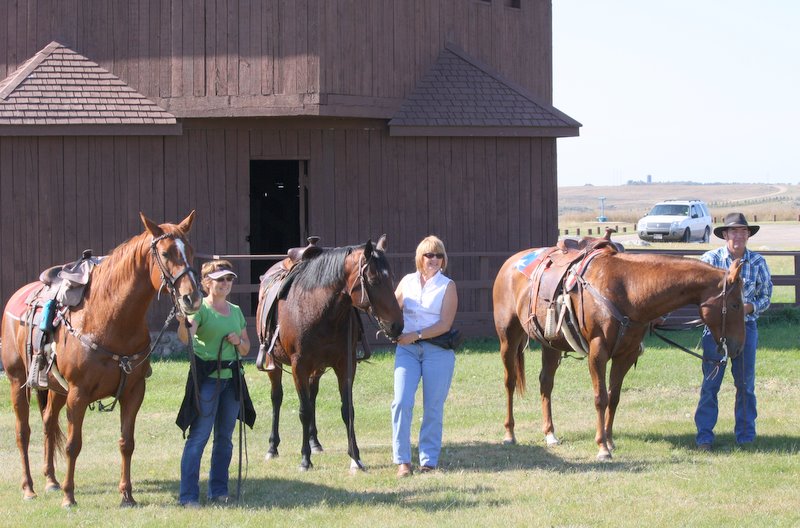
Three riders brought their horses from Steele to ride the grounds and hills of the park's acreage. They asked us to take pictures of them with their cameras, and I just happened to have mine along to snap one for myself.


Mary thought this scene of a blockhouse with the state capitol building in the background to be picture worthy. The old and the new? No one standing lookout at the fort could ever have envisioned this modern building standing tall against the sky. What they would have seen would have been the old Edwinton with a small cluster of bars, whorehouses, and dwellings.


Here is my darling wife. I was so proud of her since she climbed the ladders to the top, too. A few years ago she would not do it, but today I suppose she did not want me to have all the fun. The river bed from this point appears desolate now with all the drowned, dead brush, the layer of silt covering the area, and the newly deposited, shapeless sandbars rising above the water.

Thursday, September 29, 2011

Twin Buttes

Last Sunday when we took the "cup and saucer" tour to Almont I wanted to visit something else, too. I am reading the book Following the Custer Trail of 1876 by Laudie J. Chorme; having researched history and diaries of the participants he constructed a day by day itinerary of the 7th Cavalry's journey from Fort Abraham Lincoln to the famous Battle of the Little Big Horn. From their Indian guides the soldiers learned the Indians called these two hillocks pictured here "Maiden's Breasts Buttes," a sight they saw on their fifth day of march. They are known today as Twin Buttes.

We have driven past them many times whenever we'd travel westward along I-94, but I never thought a lot about them except that I told my wife that these hills reminded me of something closely akin to what the 7th Cavalry thought. As a point of reference they are near the community of Glen Ullin.

Mark Kellogg, a reporter for the Bismarck Tribune, accompanied the march,who, by the way, died a few days later with Custer. He wrote of this site: "Yonder, in the southwest, at a distance of perhaps twenty miles, are to be seen, rising as if from the ocean, two symmetrical buttes shaped exactly alike,and resembling a pair of graceful cups inverted. They stand alone upon what otherwise would be an unbroken sea of living green verdure, decked throughout by beds of wild flowers. Our Indian guide observed that our attention has been attracted to his pair of beautiful hillocks, but, Indian-like, will not volunteer to gratify our curiosity until asked to do so. To our inquiry as to the name of the two buttes, he replied, 'Maiden's Breasts.' There were many hilarious remarks passed among the soldiers as they viewed these two hillocks."

The narrative of the book describes the trip as being arduous with a lot of misery, suffered by men and animals alike. About 150 infantry marched with the column, on foot of course as infantry would be expected to do as defense for the large number of supply wagons. But another group of about 75 also marched on foot, even though they were cavalry. There were not enough mounts at the fort for them to ride. Apparently the requisition for them had not yet been filled before they left the fort. So they marched in their riding boots, high-heeled, pointy toes, unsuitable for walking. Blisters, swollen feet, back aches, etc. made them miserable.

Monday, September 26, 2011

A Cup and Saucer

Some time ago I ran across a story that interested me a great deal. After reading about it I knew that I wanted to visit the site for myself and see it with my own two eyes. On Sunday Mary and I drove to Almont, about 25 miles west of Mandan. The story went like this: a poor African-American family passed through Almont in 1926. Their infant son Jonathan took ill and died, and his parents buried him in the local cemetery. The parents were too poor to pay for a headstone, but they left on the grave their most prized possession, a china cup and saucer. Needless to say, items of this nature, being fragile, are subject to damage from our harsh weather conditions, maybe even vandalism. A resident of the town assumed the responsibility of replacing the cup and saucer whenever needed. She has since passed on, however, but people from the town carry on the task of caring for the site.

A small metal headstone now marks the grave inscribed with the infant's name and year of death, a project probably undertaken by a sympathetic person or group. But no doubt about it, the cup and saucer rest prominently in front of the marker. Probably not many people from outside the community of Almont know of this story; I'm glad I read a small article that called attention to it so we could visit the scene and pay our respects.


Almont is a small town, and as I suspected when we drove in we would not find anyone to direct us to the cemetery. A few months ago as a young restaurant waitress took our order whom I asked where she was from. With Almont her answer I asked if she knew about the cup and saucer, which she did. I thought I remembered her saying it was a couple miles east of town, and sure enough, we found it.

Saturday, September 24, 2011

A Champion Dies

Sad news came last week; one of my sports heroes, a real champion, passed away at the age of 15. His name was Little Yellow Jacket, a three time World Champion bucking bull. He became a commercial enterprise for his owners here in Mandan, but how can anyone feel sorry for a bull that never had to work more than 8 seconds on an occasional basis, and usually much less than 8 seconds because he threw his wannabee riders in less than that.


We saw this bull during his last North Dakota appearance and it was a thrill to watch him at the Bullarama where he bucked off the rider in short time.


It was quite the sporting event when the world champion rider Chris Shivers climbed aboard during a highly-hyped event where he would have won one million dollars if he had stayed on 8 seconds. He didn't. He lasted all of two seconds. In later years the bull has been bred to many cows to raise more bulls with his genetics.

Thursday, September 22, 2011

Who Said It Would Be Easy?

Custer's Last Stand has been portrayed in many paintings, and here is another. I've been doing a lot of reading about this period and have found many references to Custer. His story is an incidental result, though, because I'm more interested in the people around him. When he left Fort Abraham Lincoln for his massacre just a couple miles south of where I write, he took along quite a gathering of men, animals, material, and equipment. Twelve hundred men, 1600 animals, 250 wagons, private contractors to freight food and supplies, etc.

General Terry, head of the two mile column, said that the 16oo animals ate at the rate of 12,000 pounds and more of grain per day which was equivalent to the contents of three of the heavy wagons. In another of his diary entries he said they found ground very soft in places and the mules had great difficulty in pulling the wagons. Only by doubling up the teams could they get through.

Other sources talk of some unmounted cavalry who were not issued horses because of the shortage marched like the infantry, but their riding boots were very unsuited to walking. Rattlesnakes existed in profusion. Hooves and boots balled up with soft gumbo. Food was bad. Hailstorms badly bruised them. Stampedes needed to be dealt with, etc. It was not an easy march.

The first poet to write and publish poetry in what is now the state of North Dakota was Enoch George Adams, a captain in the 1st U. S. Volunteer Infantry stationed at Fort Rice which is situated just a few miles south of Fort Lincoln. Here is one of his poems published in 1865 which expresses his displeasure with the life:

What the American Eagle Thinks of Dacotah

The American eagle has flown to the West,
Leaving the land that she loveth best,
Has gone to Dacotah to dwell in the wild,
A land on which God in his mercy ne'er smiled,
Which Missouri flows through with its river of mud,
Where no flowers ever blossom or trees ever bud,
Save the cottonwood mean or the willow so tough;
If you've split them or burnt them you know well enough.
And there she has perched on a wild deseert cliff
To take of the air that's around her a sniff.
She hears an old wolf that comes out of his den;
He switches his tail and then burrows again.
She sees a small prairie dog come forth to bark,
Then retire once more to his hermitage dark.
Then she spies in a thicket of cottonwood brush
An elk through the wilderness go with a rush,
Then a buffalo herd canter by with a roar,
Shake their tails and their horns till she sees them no more.
Then an Indian at last in his skins and his paint
Gives the air that's around her a repulsive taint.
A flock of lean buzzards wheel off in the blue
To add to the desolate cast of the view.
The earth it is bare wherever she looks.
She sees neither fountains nor clear water brooks
And plains like Sahara where simoons have swept
And hills on whose summits no dew ever wept.
"If this is the land of Dacotah," she cries
"I pity the 1st U. S. V. at Fort Rice."
Then plumes her gay wings and soars far from the scene
To lands more delightful and skies more serene.

Wednesday, September 21, 2011

What Kind of Education

Granted, I think about things like this from a prejudiced viewpoint, but I am a proponent of the liberal arts curriculum in education. The September 19th issue of Newsweek carried an article entitled "Texting Makes U Stupid." The first paragraph stated, The good news is that today's teenagers are avid readers and prolific writers. The bad news is that what they are reading and writing text messages. Some disheartening statistics were quoted, such as half of today's teenagers don't read books except when they're made to. Another, two thirds of college freshmen read for pleasure less than an hour per week.

This past Monday evening we accompanied our son's family to watch our grandchildren while they participated in a gymnastics organization. Because of the young age, all of the kids were accompanied by one or both parents. In a seating section I noted most of them concentrated on watching the screen on a cell phone or laptop computer. Only one individual out of that group from an open book, a thick one at that.

On a trip a year or so ago we sat with another couple at a meal on our tour group where the topic of education came up. I proceeded to expound on my feelings, but they took me up short by saying both of their kids only went to two year trade schools and were doing very well financially, thank you. I bit my tongue and didn't pursue it, but I can't help thinking there is more to life than the drudgery of manual labor that brings a big paycheck that gets spent on recreational items: motorcycles, snowmobiles, boats, lake cabins, etc. I know some of them stew and fret about making the payments on all of these depreciating "things."

I get a lot of junk email, especially from those who call themselves conservatives where the subject almost always is how terrible things are in Washington right now, and how they won't get better until their side gets back in power. If I thought they had reasoned it through for themselves I might give it more credibility, but they are usually victims of jingoisms and Limbaugh bowel movements. That is where the strengths of a serious liberal arts education shine. As one academic said, "It makes them more reflective about their beliefs and choices, more self-conscious and critical of their presuppositions and motivations, more creative in their problem-solving, more perceptive of the world around them, and more able to inform themselves about the issues that arise in their lives, personally, professionally, and socially."

Aw, hell, what do I care. Here's an Ole and Lena story. Ole and Lena were leaning against the edge of their pig-pen when Lena wistfully recalled that the next week would mark their golden wedding anniversary. "Let's have a party, Ole, let's kill a pig." Ole scratched his grizzled head. "Uff da!" he finally answered. "I don't see vhy dat pig should take the blame for something dat happened fifty years ago."

Monday, September 19, 2011

On the Road

This Monday morning we are sitting in Richfield, MN. Yesterday Mary wanted to participate in a Germans from Russia research group meeting at Concordia University in St. Paul, so down we come with little ole me the chauffeur. Actually to get us from Clint and Robyn's place in Richfield they acted as chauffeurs to get us to Concordia. I hate the thought of trying to find my way around here and driving in this traffic.

I stayed with Mary at Concordia, and having my little laptop with me, I was able to find a quiet spot and write more on my story. The opening paragraph goes like this: From the top of the northern-most blockhouse a sentry stood in his sweat-soaked uniform looking out over the hill where the burning sun beat down, as it had for several days. No one in the garrison could escape this heat, not even after the sun had set and the dark of the night closed in around them. The only green the trooper could find as he surveyed the countryside was in the grass surrounding the flowing spring at the bottom of the hill. There, two girls, maybe eight or nine years of age, kneeled to fill water bags with the clear, cool liquid. They were members of a camp of halfbreeds pitched just outside the fort, having gathered there to trade for goods in the suttler's store. When they finished, he watched them lift their containers into a small cart, slap the reins of the back of a pony, and start back. The girls seemed to be enjoying their chore even though they made the trip to the spring several times a day, laughing and chirruping as they bounced along.

The story tells of an occurrence at Fort Ransom in 1867 when a huge prairie fire roared upon the camp, and sadly, caught the two girls as they tried to escape in their cart.

Thursday, September 15, 2011

Change


We are always pulled and pushed this way or that to change our way of thinking. I wonder if the editor of the Sheldon newspaper of 1885 had any results with the following harangue when he scolded: Some of our young gents, not having the fear of their creator before their eyes, indulged in a match game of baseball last Sunday. Don't do so any more, boys. We don't know if he, the editor, was the one offended or a clergyman who found boys in a game of baseball to be so offensive to the spirit of the sabbath, but think how the times have changed. Try to convince participants or spectators with that line today; it would fall on deaf ears.

Fall draws closer. The leaves on the cottonwoods appear to have dried prematurely and have started to fall. Now we learn that they suffer from a leaf rust which caused it. At any rate their cousin-species will soon change their colors, too.

The Republican wanna-bees cry for change. They fight and squabble amongst themselves, and the only thing I hear them agree on is they want a change of president. Why they fought Obama so much and refused to cooperate with him is still a bit of a mystery, but that happened from the outset. He may have trouble being re-elected in this political climate, but I wish the choices exhibited a bit more quality.

I just returned from the barber shop. Yes, there has been a change --- from dark brown to white.

My parents experienced lots of change in their lifetimes. They straddled two different eras by being born when the draft horse and their bare hands supplied the power to run the machines to this day of piston powered or electronic labor saving devices. A farmer put up his hay with horses and pitchforks, but now he doesn't need to leave the comfort of his air-conditioned tractor cab.

I am trying to change some things in my own life before it becomes too late. I have too many stories floating around in my head that need to be told in writing. I farmed out my first short story to five different readers with literary knowledge asking them for comment. Their responses have begun to arrive, mostly positive, so I will do a re-write, but in the meantime I have started number two. Stay tuned.