Saturday, October 08, 2011

The Lightning-Rod Man


"But spite of my treatment, and spite of my dissuasive talk of him to my neighbors, the lightning-rod man still dwells in the land; still travels in storm-time, and drives a brave trade with the fears of man." - Final sentence in The Lightning-Rod Man by Herman Melville

In the story of The Lightning-Rod Man a lightning-rod salesman knocks on the home-owner's door in the middle of a storm. This home-owner does not usually give much time to salesmen but, because it is raining outside and the man is wet, he invites him inside and proceeds to make the man feel comfortable. In the midst of the terrible thunder and lightning outside, the salesman begins with his pitch, but the home-owner counters it with his mild style of resistance. As the story progresses the salesman ratchets up his pressure trying to convince the home-owner that he must have a lightning-rod for his home and is even so brazen as to "command" the man to buy one. That, of course, is the last straw, and he physically ejects the salesman and breaks his salesman's sample lightning-rod for good measure.

The author, the Herman Melville of Moby Dick fame, lived and wrote in the 19th century, but it seems to me that his story resonates today and stands as a metaphor for pressures we experience. Many types of "lightning-rod salesman" work with their high-pressure tactics playing on our fears to persuade us of the "right" way to think. It is easy to identify a few situations which we are often confronted with:

* The economy - who is to blame, how can it be fixed, Keynesian, trickle-down, ...
* The Congress - represent interest groups, money influenced, always campaigning, ...
* China - friend, foe, can't live with 'em, can't live without 'em, ...
* The President - good, bad, inexperienced, brave, indecisive, not born in the US, ...
* Iraq, Afghanistan - necessary wars, pull out the troops, ...
* Universal health care - yes, no, socialistic, privatize, ...
* Social Security- in danger, easy fix, private accounts, ...
* Climate change - man-made, yes, no, ...
* The latest fad - Tea Party, Occupy Wall Street, ...
* etc, etc...

I like how an old written work of literature like Melville's can be so thought-provoking. The internet hosts many sites where stories and novels can be read. The one I reference above came from www.americanliterature.com.

Thursday, October 06, 2011

Thirty-four Dollars


I always go crazy at the Bismarck Public Library book sale held twice eacy year. Some of the books offered are culls from the library's shelves, but for the most part they have been donated by interested parties, yours truly included. For a mere $34 I purchased those pictured above. Anyone who frequents stores such as Barnes and Noble knows that $34 can easily be spent on one book.

The author John LeCarre wrote three of the books. He is known as a writer of spy thrillers. This summer with the 9/11 Symposium
one of the speakers was a "spook," that is to say worked for one of the intelligence agencies in Washington. He mentioned that some good books have been written about international spying, but I didn't catch who he said. Later in the hallway I asked him for his recommendation, and he said John LeCarre writes very well and accurately about this business.

A copy of Stephen Ambrose's Band of Brothers begged me to buy it, as well as his Undaunted Courage. Neither could I walk away without buying Edmund Morris' Teddy Roosevelt story entitled Theodore Rex, James McPherson's Battle Cry of Freedom, and David McCullough's The Path Between the Seas.

I don't want to go on naming books, but one other I thought I should buy was James Michener's Hawaii. I've read it before, some time ago, but since we travel to Hawaii in January I wanted to reread it. Any of Michener's books are very descriptive of the area and times he writes about, so I want to get familiar with Hawaii again before getting there.

They had more books there than I have seen at previous sales, and many of them still set below the tables in their boxes because there wasn't enough room to bring them up to display. I am quite sure I shall return.

Posted by Picasa

Wednesday, October 05, 2011

Middle Age?


* If I am middle-aged, does that mean I should expect to be still living when I'm 138 years old?

* I believe in science, therefore releasing Amanda Knox was the right thing to do.

* I just might grow to like Governor Christie of New Jersey. He seems to be a man of his word, when he said he wasn't ready to run for president, he meant it. I'll take another look in 4 years.

* My AARP Bulletin says I can help trim the national debt by skipping the cookies. How? Saving health care costs.

* North Dakota is in third place behind New Hampshire and Montana in beer consumption. Our people drink 29.8 gallons each.I wonder who is drinking my share?

* Mexico says they want tourists back. I'm not about to lose my head to take that chance.


* Ole bought Lena a piano for her birthday. A few weeks later, Sven asked how she was doing with it. "Oh," said Ole, "I had her switch to a clarinet." "How come," asked Lars. "Vell," Ole answered, "because with a clarinet she can't sing."

* I think I went through this phase: "Never retract, never explain, never apologize; get things done and let them howl." Nellie McClung

* Tomorrow morning (Thursday) I will attend one of my favorite events, the book sale at the Bismarck Public Library. I always come away with way too many books.

* We washed windows today. Mary has put her flowers to bed for the winter. Winter is a-comin'!


Posted by Picasa

Sunday, October 02, 2011

Fort Abraham Lincoln


We had been wanting to go to Fort Abraham Lincoln all summer, but for reasons since forgotten we never did until today, Sunday. It was the short tour, the one where we drove to the top of the hill to where the infantry post was located and climbed the ladders inside the blockhouses to their observation decks. The Missouri and the confluence of the Heart River flow far below this vantage point. One looks out over the flat plain below and to the cavalry post positioned on it and sees how accessible water was for the needs of the large herd of horses kept as mounts.

Standing atop the blockhouses I thought of the history associated with this site. Only recently I learned how harsh life would have been for the infantry. About 160 of them marched from here on foot, of course, as guards for the slow moving wagon train accompanying the 7th Cavalry as they headed for the Little Big Horn. Harsher yet was the suffering of the seventy or so cavalrymen who had no horses to ride. Their riding boots caused blisters and sore feet to form as they walked along.

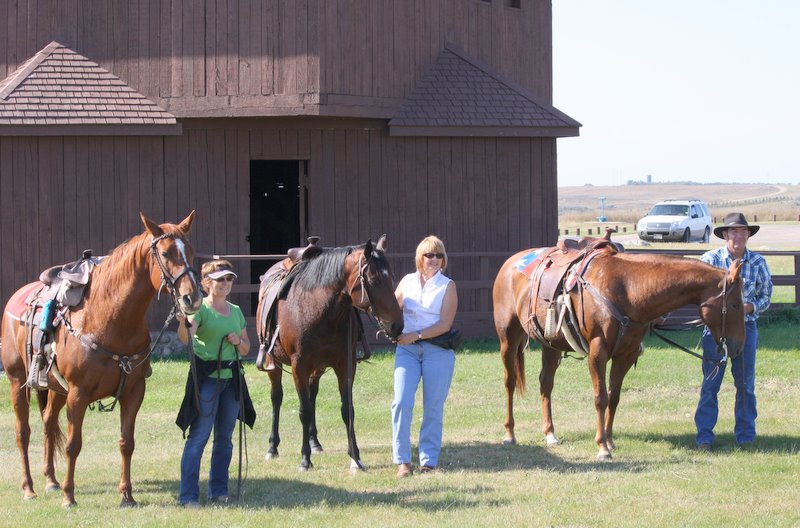
Three riders brought their horses from Steele to ride the grounds and hills of the park's acreage. They asked us to take pictures of them with their cameras, and I just happened to have mine along to snap one for myself.


Mary thought this scene of a blockhouse with the state capitol building in the background to be picture worthy. The old and the new? No one standing lookout at the fort could ever have envisioned this modern building standing tall against the sky. What they would have seen would have been the old Edwinton with a small cluster of bars, whorehouses, and dwellings.


Here is my darling wife. I was so proud of her since she climbed the ladders to the top, too. A few years ago she would not do it, but today I suppose she did not want me to have all the fun. The river bed from this point appears desolate now with all the drowned, dead brush, the layer of silt covering the area, and the newly deposited, shapeless sandbars rising above the water.

Thursday, September 29, 2011

Twin Buttes

Last Sunday when we took the "cup and saucer" tour to Almont I wanted to visit something else, too. I am reading the book Following the Custer Trail of 1876 by Laudie J. Chorme; having researched history and diaries of the participants he constructed a day by day itinerary of the 7th Cavalry's journey from Fort Abraham Lincoln to the famous Battle of the Little Big Horn. From their Indian guides the soldiers learned the Indians called these two hillocks pictured here "Maiden's Breasts Buttes," a sight they saw on their fifth day of march. They are known today as Twin Buttes.

We have driven past them many times whenever we'd travel westward along I-94, but I never thought a lot about them except that I told my wife that these hills reminded me of something closely akin to what the 7th Cavalry thought. As a point of reference they are near the community of Glen Ullin.

Mark Kellogg, a reporter for the Bismarck Tribune, accompanied the march,who, by the way, died a few days later with Custer. He wrote of this site: "Yonder, in the southwest, at a distance of perhaps twenty miles, are to be seen, rising as if from the ocean, two symmetrical buttes shaped exactly alike,and resembling a pair of graceful cups inverted. They stand alone upon what otherwise would be an unbroken sea of living green verdure, decked throughout by beds of wild flowers. Our Indian guide observed that our attention has been attracted to his pair of beautiful hillocks, but, Indian-like, will not volunteer to gratify our curiosity until asked to do so. To our inquiry as to the name of the two buttes, he replied, 'Maiden's Breasts.' There were many hilarious remarks passed among the soldiers as they viewed these two hillocks."

The narrative of the book describes the trip as being arduous with a lot of misery, suffered by men and animals alike. About 150 infantry marched with the column, on foot of course as infantry would be expected to do as defense for the large number of supply wagons. But another group of about 75 also marched on foot, even though they were cavalry. There were not enough mounts at the fort for them to ride. Apparently the requisition for them had not yet been filled before they left the fort. So they marched in their riding boots, high-heeled, pointy toes, unsuitable for walking. Blisters, swollen feet, back aches, etc. made them miserable.

Monday, September 26, 2011

A Cup and Saucer

Some time ago I ran across a story that interested me a great deal. After reading about it I knew that I wanted to visit the site for myself and see it with my own two eyes. On Sunday Mary and I drove to Almont, about 25 miles west of Mandan. The story went like this: a poor African-American family passed through Almont in 1926. Their infant son Jonathan took ill and died, and his parents buried him in the local cemetery. The parents were too poor to pay for a headstone, but they left on the grave their most prized possession, a china cup and saucer. Needless to say, items of this nature, being fragile, are subject to damage from our harsh weather conditions, maybe even vandalism. A resident of the town assumed the responsibility of replacing the cup and saucer whenever needed. She has since passed on, however, but people from the town carry on the task of caring for the site.

A small metal headstone now marks the grave inscribed with the infant's name and year of death, a project probably undertaken by a sympathetic person or group. But no doubt about it, the cup and saucer rest prominently in front of the marker. Probably not many people from outside the community of Almont know of this story; I'm glad I read a small article that called attention to it so we could visit the scene and pay our respects.


Almont is a small town, and as I suspected when we drove in we would not find anyone to direct us to the cemetery. A few months ago as a young restaurant waitress took our order whom I asked where she was from. With Almont her answer I asked if she knew about the cup and saucer, which she did. I thought I remembered her saying it was a couple miles east of town, and sure enough, we found it.

Saturday, September 24, 2011

A Champion Dies

Sad news came last week; one of my sports heroes, a real champion, passed away at the age of 15. His name was Little Yellow Jacket, a three time World Champion bucking bull. He became a commercial enterprise for his owners here in Mandan, but how can anyone feel sorry for a bull that never had to work more than 8 seconds on an occasional basis, and usually much less than 8 seconds because he threw his wannabee riders in less than that.


We saw this bull during his last North Dakota appearance and it was a thrill to watch him at the Bullarama where he bucked off the rider in short time.


It was quite the sporting event when the world champion rider Chris Shivers climbed aboard during a highly-hyped event where he would have won one million dollars if he had stayed on 8 seconds. He didn't. He lasted all of two seconds. In later years the bull has been bred to many cows to raise more bulls with his genetics.

Thursday, September 22, 2011

Who Said It Would Be Easy?

Custer's Last Stand has been portrayed in many paintings, and here is another. I've been doing a lot of reading about this period and have found many references to Custer. His story is an incidental result, though, because I'm more interested in the people around him. When he left Fort Abraham Lincoln for his massacre just a couple miles south of where I write, he took along quite a gathering of men, animals, material, and equipment. Twelve hundred men, 1600 animals, 250 wagons, private contractors to freight food and supplies, etc.

General Terry, head of the two mile column, said that the 16oo animals ate at the rate of 12,000 pounds and more of grain per day which was equivalent to the contents of three of the heavy wagons. In another of his diary entries he said they found ground very soft in places and the mules had great difficulty in pulling the wagons. Only by doubling up the teams could they get through.

Other sources talk of some unmounted cavalry who were not issued horses because of the shortage marched like the infantry, but their riding boots were very unsuited to walking. Rattlesnakes existed in profusion. Hooves and boots balled up with soft gumbo. Food was bad. Hailstorms badly bruised them. Stampedes needed to be dealt with, etc. It was not an easy march.

The first poet to write and publish poetry in what is now the state of North Dakota was Enoch George Adams, a captain in the 1st U. S. Volunteer Infantry stationed at Fort Rice which is situated just a few miles south of Fort Lincoln. Here is one of his poems published in 1865 which expresses his displeasure with the life:

What the American Eagle Thinks of Dacotah

The American eagle has flown to the West,
Leaving the land that she loveth best,
Has gone to Dacotah to dwell in the wild,
A land on which God in his mercy ne'er smiled,
Which Missouri flows through with its river of mud,
Where no flowers ever blossom or trees ever bud,
Save the cottonwood mean or the willow so tough;
If you've split them or burnt them you know well enough.
And there she has perched on a wild deseert cliff
To take of the air that's around her a sniff.
She hears an old wolf that comes out of his den;
He switches his tail and then burrows again.
She sees a small prairie dog come forth to bark,
Then retire once more to his hermitage dark.
Then she spies in a thicket of cottonwood brush
An elk through the wilderness go with a rush,
Then a buffalo herd canter by with a roar,
Shake their tails and their horns till she sees them no more.
Then an Indian at last in his skins and his paint
Gives the air that's around her a repulsive taint.
A flock of lean buzzards wheel off in the blue
To add to the desolate cast of the view.
The earth it is bare wherever she looks.
She sees neither fountains nor clear water brooks
And plains like Sahara where simoons have swept
And hills on whose summits no dew ever wept.
"If this is the land of Dacotah," she cries
"I pity the 1st U. S. V. at Fort Rice."
Then plumes her gay wings and soars far from the scene
To lands more delightful and skies more serene.

Wednesday, September 21, 2011

What Kind of Education

Granted, I think about things like this from a prejudiced viewpoint, but I am a proponent of the liberal arts curriculum in education. The September 19th issue of Newsweek carried an article entitled "Texting Makes U Stupid." The first paragraph stated, The good news is that today's teenagers are avid readers and prolific writers. The bad news is that what they are reading and writing text messages. Some disheartening statistics were quoted, such as half of today's teenagers don't read books except when they're made to. Another, two thirds of college freshmen read for pleasure less than an hour per week.

This past Monday evening we accompanied our son's family to watch our grandchildren while they participated in a gymnastics organization. Because of the young age, all of the kids were accompanied by one or both parents. In a seating section I noted most of them concentrated on watching the screen on a cell phone or laptop computer. Only one individual out of that group from an open book, a thick one at that.

On a trip a year or so ago we sat with another couple at a meal on our tour group where the topic of education came up. I proceeded to expound on my feelings, but they took me up short by saying both of their kids only went to two year trade schools and were doing very well financially, thank you. I bit my tongue and didn't pursue it, but I can't help thinking there is more to life than the drudgery of manual labor that brings a big paycheck that gets spent on recreational items: motorcycles, snowmobiles, boats, lake cabins, etc. I know some of them stew and fret about making the payments on all of these depreciating "things."

I get a lot of junk email, especially from those who call themselves conservatives where the subject almost always is how terrible things are in Washington right now, and how they won't get better until their side gets back in power. If I thought they had reasoned it through for themselves I might give it more credibility, but they are usually victims of jingoisms and Limbaugh bowel movements. That is where the strengths of a serious liberal arts education shine. As one academic said, "It makes them more reflective about their beliefs and choices, more self-conscious and critical of their presuppositions and motivations, more creative in their problem-solving, more perceptive of the world around them, and more able to inform themselves about the issues that arise in their lives, personally, professionally, and socially."

Aw, hell, what do I care. Here's an Ole and Lena story. Ole and Lena were leaning against the edge of their pig-pen when Lena wistfully recalled that the next week would mark their golden wedding anniversary. "Let's have a party, Ole, let's kill a pig." Ole scratched his grizzled head. "Uff da!" he finally answered. "I don't see vhy dat pig should take the blame for something dat happened fifty years ago."

Monday, September 19, 2011

On the Road

This Monday morning we are sitting in Richfield, MN. Yesterday Mary wanted to participate in a Germans from Russia research group meeting at Concordia University in St. Paul, so down we come with little ole me the chauffeur. Actually to get us from Clint and Robyn's place in Richfield they acted as chauffeurs to get us to Concordia. I hate the thought of trying to find my way around here and driving in this traffic.

I stayed with Mary at Concordia, and having my little laptop with me, I was able to find a quiet spot and write more on my story. The opening paragraph goes like this: From the top of the northern-most blockhouse a sentry stood in his sweat-soaked uniform looking out over the hill where the burning sun beat down, as it had for several days. No one in the garrison could escape this heat, not even after the sun had set and the dark of the night closed in around them. The only green the trooper could find as he surveyed the countryside was in the grass surrounding the flowing spring at the bottom of the hill. There, two girls, maybe eight or nine years of age, kneeled to fill water bags with the clear, cool liquid. They were members of a camp of halfbreeds pitched just outside the fort, having gathered there to trade for goods in the suttler's store. When they finished, he watched them lift their containers into a small cart, slap the reins of the back of a pony, and start back. The girls seemed to be enjoying their chore even though they made the trip to the spring several times a day, laughing and chirruping as they bounced along.

The story tells of an occurrence at Fort Ransom in 1867 when a huge prairie fire roared upon the camp, and sadly, caught the two girls as they tried to escape in their cart.

Thursday, September 15, 2011

Change


We are always pulled and pushed this way or that to change our way of thinking. I wonder if the editor of the Sheldon newspaper of 1885 had any results with the following harangue when he scolded: Some of our young gents, not having the fear of their creator before their eyes, indulged in a match game of baseball last Sunday. Don't do so any more, boys. We don't know if he, the editor, was the one offended or a clergyman who found boys in a game of baseball to be so offensive to the spirit of the sabbath, but think how the times have changed. Try to convince participants or spectators with that line today; it would fall on deaf ears.

Fall draws closer. The leaves on the cottonwoods appear to have dried prematurely and have started to fall. Now we learn that they suffer from a leaf rust which caused it. At any rate their cousin-species will soon change their colors, too.

The Republican wanna-bees cry for change. They fight and squabble amongst themselves, and the only thing I hear them agree on is they want a change of president. Why they fought Obama so much and refused to cooperate with him is still a bit of a mystery, but that happened from the outset. He may have trouble being re-elected in this political climate, but I wish the choices exhibited a bit more quality.

I just returned from the barber shop. Yes, there has been a change --- from dark brown to white.

My parents experienced lots of change in their lifetimes. They straddled two different eras by being born when the draft horse and their bare hands supplied the power to run the machines to this day of piston powered or electronic labor saving devices. A farmer put up his hay with horses and pitchforks, but now he doesn't need to leave the comfort of his air-conditioned tractor cab.

I am trying to change some things in my own life before it becomes too late. I have too many stories floating around in my head that need to be told in writing. I farmed out my first short story to five different readers with literary knowledge asking them for comment. Their responses have begun to arrive, mostly positive, so I will do a re-write, but in the meantime I have started number two. Stay tuned.

Monday, September 12, 2011

Visitors

To me, one of life's great pleasures is welcoming old friends into our home and enjoying each other's company for a long visit. Dick Schroeder and I grew up together and experienced many things together. On Monday, he and his wife Karen arrived to stay the night with us as they journeyed to St. Paul. Their main reason for traveling through was to visit with Karen's aged mother. Coming across Canada they had stayed the previous night in Moosejaw, Sask.

Dick and I have not done much visiting over the last 50 years or so and a lot of reminiscing needed to get done. He retired from an accounting career and Karen from her job as nurse practitioner.


A highlight from most of our visitors' visits is to tour Mary's gardens. Here they inspect an arbor which caught Karen's eye, after which she told Dick she wants one too. His reaction seemed to be, "We haven't got the room in our small yard." Next year I want to remember to ask them who won out on this matter.

When they drove off the house seemed empty, but we had a good time while it lasted.

Sunday, September 11, 2011

Twin Towers Burning, 9/11

Ten years ago this happened. I remember very well where I heard about it. Coming in from the road I checked into the office of my part-time job and the receptionist there asked, "Have you heard the news?" I hadn't, and I went to a radio to try to find news and could not wait until my work day ended and I could get home to CNN.

Yesterday was the second of the symposium Impact on the Heartland. Another great lineup of speakers presented their views of the event:

1. Julia Ernst - faculty member of the school of law talked on the U. S. Constitution, the rule of law, and the age of terrorism.

2. Chris Bailey - staff of the National Intelligence University discussed issues in U. S. intelligence.

3. Gerard Jacobs - University of South Dakota, The evolution of mental health in an age of disasters.

4. Master Sergeant Mike Carswell, USAF - He was in the Pentagon when the plane hit and spoke of his post traumatic stress disorder since then.

5. Geoffrey Wawro, author and faculty of Universityof North Texas, the war on terror and its progress and pitfalls.

6. Major General David Sprynczynatyk (spell that without looking) , Adjutant General of the N. D. National Guard, ten years supporting the global war on terror.

7. Manochehr Dorraj, faculty of Texas Christian University, U. S. - Muslim Relations since 2011

8. etc., etc.

To cap the day we laid out some big bucks and donned some nice clothes and attended a symphony performance called A Place of Remembrance with the Bismarck-Mandan Symphony Orchestra, the Bismarck-Mandan Civic Chorus, and the University of Mary Chorus.

Now today I am going to take a nap before my old friend and classmate arrive to spend the evening with us, Dick Schroeder and wife.

Friday, September 09, 2011

Twin Towers on 9/11

Today was the first day of the Impact on the Heartland Symposium held at Bismarck State College. Because of the work of a few scholars and humanities promoters in this community I am able to enjoy many convocations like it in this community. The line-up of speakers today held the audience's attention:

1. General Charles F. Wald, USAF (ret.) - A four star general originally from North Dakota gave his insights on America's response to 9/11.

2. Lt. Col. Dean Eckmann, ND Air National Guard - flew with the three Happy Hooligans in their F-16's when they were the first called upon to fly over the capital preventing any further attacks on 9/11 and for many days after.

3. Jenette Nelson - North Dakota mother of a girl killed in the attack.

4. Marcel Sim - A paramedic who set up the first treatment and triage location at Ground Zero.

5. Chuck Roberts - a broadcast journalist who worked for CNN's Headline News when the attack occurred.

6. Thomas Frank - author and heartland populist who studies propaganda techniques, including how we were led to invade Iraq.

7. A panel of North Dakota Statesmen consisting of Senator Conrad, Senator Hoeven, Governor Dalrymple, Lieutenant Governor Wrigley, and former Congressman Earl Pomeroy.

Now, just having returned from the evening speaker I can finish writing. Peter Bergen spoke about his knowledge of Al-Qaeda. He was the first journalist to be granted an interview with Osama bin Laden. He speaks very knowledgeably and has held positions with CNN and ABC as well as with many professional organizations.

Tomorrow is another full line-up and I will be there.

Wednesday, September 07, 2011

Pickin' Things

I like this picture. When I developed it the colors came out so bright! Not much going on around the old homestead, mostly thinking things. I finished a short story and have sent it to a few readers for their input. One answered back already with positive remarks so I'm happy for that.
It was about the wagon train of freighters who were stalled in a three day blizzard near Lisbon. I contrived a fictitious narrator to tell the story, so I guess it would be called historical fiction.

I'm ready to start another one. When Fort Ransom was still active it seems they attracted a small village of Indians, maybe half-breeds who camped on the outskirts. One summer after the grass withered and dried, what was probably a lightning strike on the prairie started a huge racing fire. Two young Indian girls had wandered away from the camp. They were driving a pony on a little cart and when they realized a fire cut them off from their camp, they whipped the pony to go as fast as he could to head for the relative safety of a spring of water. They could have made it except for the fact that one of the cart's wheels broke on a rock which threw them out, and by the time they recovered it was too late. Many stories like this exist in the area where I grew up, but they are not common knowledge. They have been forgotten, surviving only in dusty pages that no one reads.

A prominent writer, Frederick Manfred, wrote many interesting books and stories and placed them in the setting he called Siouxland, the region comprising the Dakotas, Minnesota, Iowa, and Nebraska. Maybe I will have to come up with a name for my enterprise. I've got dozens of stories that need to be told that are set in my home area.

Sunday, September 04, 2011

Before It Happened


A person can imagine having the paranormal power of predicting the future if he reads old newspaper accounts dated prior to the event. Take the death of Ulysses S. Grant for instance. The February 17, 1885 edition of the Sheldon newspaper carried this: Poor old General Grant, the hero of Shiloh, the Wilderness, and so many other great battles, the boy who used to take pride in riding unbroken colts is now dying; yes, he is dying and in his death the United States loses one of the most honored men who ever lived. He died July 23, 1885.

Some one should have told the Indians I write of next who were reported in early May. Five Indians, well armed and carrying two canoes, were seen making a beeline northward yesterday. Going to join Riel? Only a couple weeks later, May 18, 1885 the paper carried this bit: Riel captured, the rebel leader now in the hands of the Dominion government. Riel was a resistance leader of the Metis people, that is half-breeds, in what is now Manitoba.

An article especially interested me since I've done a lot of reading on this topic: Thousands of head of cattle have been bought in Northwestern Iowa in the last few weeks to be taken to the large ranches in Dakota and Montana for fattening purposes. In a couple of weeks the paper reported this: Theodore Roosevelt, the prominent New York politician, has arrived at his ranch on the Elkhorn in the western part of Dakota where he expects to spend the summer. It was just a year later that history recorded that the harsh winter of 1886-87 killed hundreds of thousands of cattle and marked the end of the open range. The famous picture painted by the western artist Charley Russell was one he painted in a letter to a friend to describe how bad the winter really was.

Thursday, September 01, 2011

Butterflies and Other Things

Mary's garden keeps on delivering beautiful sights, and I took my trusty camera out yesterday to shoot some pictures. She has been telling me of these "worms" on her butterfly plant. Lo and behold, they have turned to monarch butterflies. She was surprised; she hadn't noticed yet. The paper published one similar to it today, but I think this one is better.

Speaking of the newspaper, I found a few items of interest:

- George Will's column started with this paragraph - "Beer," said Benjamin Franklin, who knew a thing or two about pleasure, "is living proof that God loves us and wants us to be happy."
- Jim Cramer's Mad Money show from and about North Dakota last week apparently prompted lots of queries from out-of-state job seekers.
- The proof reader did not catch the spelling error in the headline "Wildfire destroyes dozens of homes."
- The nation is drinking too many sweet drinks.
- Restrictions for boating on the river are lifted. All boat traffic has been banned on the usually busy river, but now they can go out at "idle speed only."
- Squatters who park for long periods in the Bismarck library lot will face a $20 fine from now on. I hope they can enforce that, sometimes when I go there the lot is full and there doesn't seem to be that many people in there.
- Another spelling error popped up: "Prairie Public celbrating 30 years."
- And the weekly bird club column says, "Cormorants are a marvel of adaptation." The last few years as we drive along I-94 we have been noticing the increase in the number of cormorants appearing in dead trees setting in sloughs. It seems like they keep moving further westward.

Tuesday, August 30, 2011

Gone Gonzo


Sometimes a man's mind goes blank
and his thoughts go to gonzo
wandering. In Medora
I asked, "Do you have cowboys
in Turkey?" and a wry smile
with "No" came back as we stood
in a line. The prairie dogs
barked when Ike stepped from the car
straining at his leash, wanting
to chase the pesky buggers.
The ladies dug crocodile
teeth from the earth which prompted
the man to say, "Hey, good one!"
I roamed the aisles of the best
bookstore this side of New York
and swapped lies with owner Doug
who dressed resplendent in togs
right out of the latest look
in old-time western vestments.
And dig deep we did to eat
in the cafes of that town
making me swear to haul fuel
in my trunk next time we came.
Teddy Roosevelt's legend
still lives on while lots of loot
gets made on his name out here.
There sat the wife of the man
who restored the town, Sheila,
who liked my poem and sent
me the book about the horse,
my hero, Tipperary.
So, my gonzo wandering
comes to an end while I get
back to writing my story
mixed with fact and fiction and
I've forgotten which is which.

Sunday, August 28, 2011

A Celebration & A Book

Yesterday we celebrated the 50th anniversary of Mary's brother and his wife, Mike and Sharon, ate lots of good food, and took a few pictures. Here is the happy couple who still live on the ranch south of Raleigh.


Being that all of Mike's sisters were present I thought this would make a good picture grouping for them to get behind Mike and Sharon for this photo. For the life of me I don't know what caused this reaction, but it looks to me as if my wife said something naughty. She will not confess so it is up to our imaginations to guess what it could have been. After they settled down, I was able to take a better one.


The couple still look young, and I told them we are making plans to celebrate their 100th.


I just finished reading a book, a book that I wished would not have ended because I enjoyed it so much - Monte Walsh. by Jack Schaefer. Schaefer also wrote another great story - Shane. A popular movie was based on Shane, but two movies followed Monte Walsh, one with Lee Marvin in the 70's and the other a made for TV movie starring Tom Selleck. I found portions of them on YouTube and enjoyed them; for some reason I never saw either one previously.

Walsh was a real rounder, a cowboy who worked hard but played even harder. As the story progressed through the years his close friend and partner on the range changed with the years, married, and became a successful businessman. Monte would have none of the modern life and rejected inventions such as the motor car that started appearing. The ranch for which he worked so loyally for many years became fenced, his friends began dying or drifting away, and at the end it was just Monte and his horse. Even though the general theme was one of sadness as it followed the character's life, there were some places where I laughed the hardest that I have for a long time.

Wednesday, August 24, 2011

The Long Count


I read reference to an old sporting event that interested me, the Tunney-Dempsey heavyweight championship boxing match of September, 1927. It was the second meeting of these two boxers, Tunney having won the first bout. The key to this being a historic bout had to do with a new rule instituted just previously to this match: after a knock down, the standing fighter had to retreat to a neutral corner. Dempsey hit Tunney with a flurry of punches to the chin in the seventh round and knocked him down, but then he stood there. The referee did not start his count until he went to the corner, a length of five seconds. Whether or not Tunney needed the extra count is not known, but he waited for the full count before he got up and then went on to win the fight. Some thought Dempsey got cheated, but years later Dempsey said, "I didn't know what I was doing, I guess I was punchy. I didn't get to my corner. Besides Tunney wasn't hurt that bad." I searched YouTube by typing in Tunney-Dempsey and a film of the bout came up. I think I agree with Dempsey, Tunney didn't look hurt.

Some of the "jock strap" writers couldn't quite deal with Tunney without making fun of his love of literature. But he was a legitimate poetry quoting intellectual. After the Dempsey fight he spoke to a Yale Shakespeare class for an hour without notes about Troilus and Cressida. He counted writers like George Bernard Shaw, Thornton Wilder, M. Somerset Maugham, and Ernest Hemingway as friends.

After the fight Tunney and Dempsey became very good friends and Tunney would take his wife to Dempsey's restaurant to dine. To me one of the reasons I like this story is that this athlete didn't get his brains scrambled and become punch drunk. He went on to have a successful business career. Of course, it didn't hurt that he married an heiress to the Andrew Carnegie fortune.